Merck Economic Moat Analysis: Rating, Trend & Competitive Advantages

Merck Economic Moat Analysis: Rating, Trend & Competitive Advantages

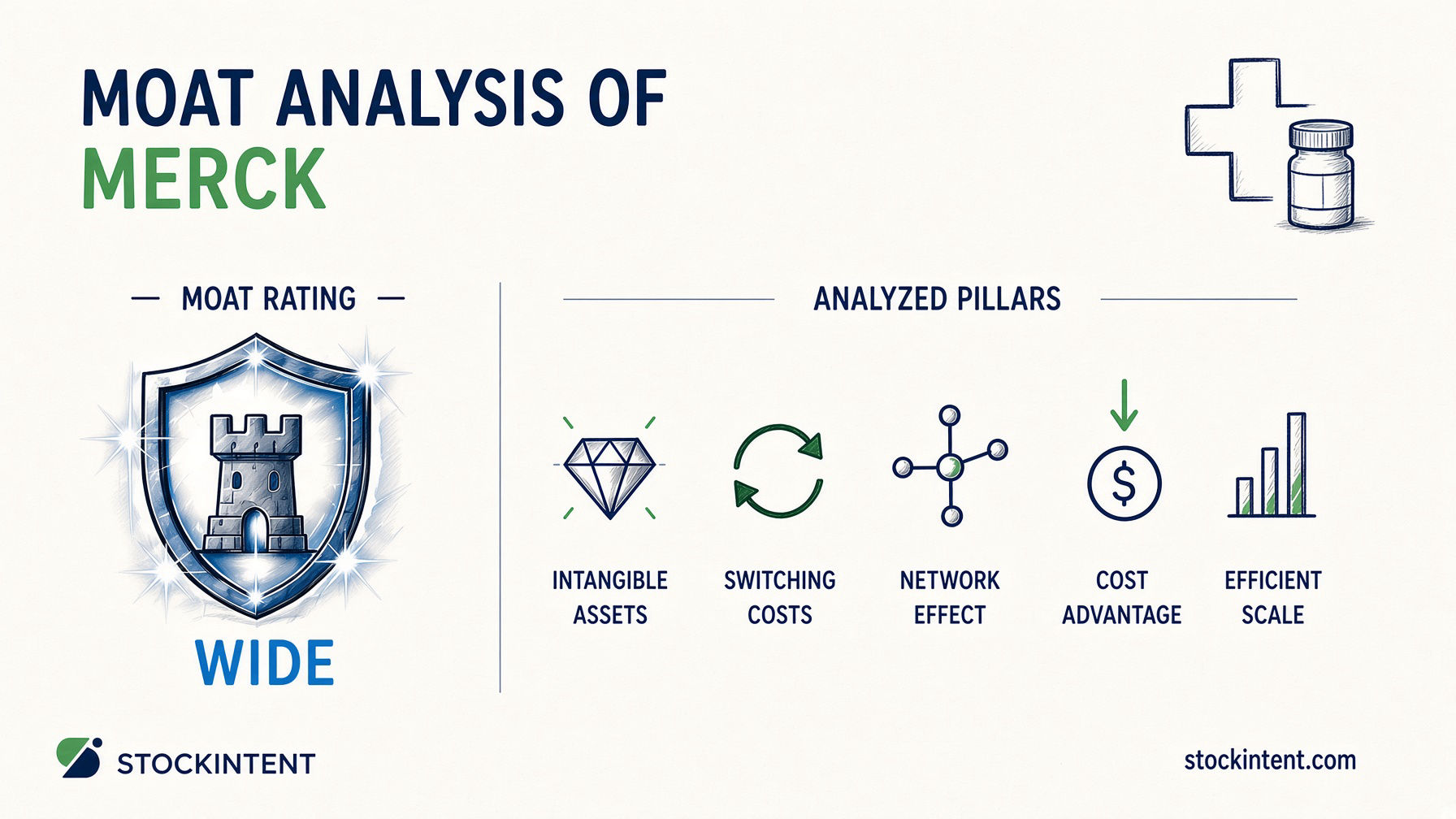
Merck carries a Wide moat today, but don't mistake current strength for permanence. Its near-term trend looks Stable as Keytruda still dominates oncology, yet the Medium-High uncertainty rating reflects a hard reality: patent protection expires in 2028, and roughly 55% of pharmaceutical sales depend on a single franchise.

Here's what matters most:

  • Strongest moat source: Intangible assets. Keytruda's patent estate runs through 2028, with additional patents potentially extending to 2029, creating legal exclusivity that competitors cannot easily circumvent.
  • Weakest pillar: Network effects. Drug adoption follows clinical evidence and payer contracts, not user-to-user reinforcement. This isn't a platform that compounds naturally.
  • Moat trend: Stable now, structurally at risk post-2028. Management's creation of a separate cancer division signals they see the cliff coming too.
  • Uncertainty level: Medium-High. High margins (~81% gross) and $8.4 billion quarterly Keytruda sales offer near-term visibility, but concentration risk and regulatory pricing pressure widen the range of plausible outcomes.

Think of Merck's moat as a premium leasehold The economics are excellent while the patent lasts, which is exactly why durability matters more than current profitability. Understanding which advantages are structural versus time-bound is the difference between buying a compounder and catching a falling knife. That's what we'll unpack in the pillar analysis next.

Merck's Competitive Advantages

Merck's moat is primarily a patent-and-biology story. The durability comes from legal exclusivity and clinical adoption inertia.

Intangible assets: strong. Keytruda's core U.S. patent protection runs through 2028, with additional method-of-making and method-of-use patents that may delay biosimilar entry into 2029. Merck's history of patent litigation settlements and license agreements shows how aggressively it defends this intellectual property. In our analysis, intangible assets are the single strongest pillar because they create a legal barrier competitors cannot replicate with superior execution alone.

Pro Insight: Merck represents a classic patent-and-biology moat rather than a network-effect story. Investors often mistakenly search for platform effects in healthcare; Merck's durability stems from legal exclusivity and clinical adoption inertia, not from user-to-user network effects.

Switching costs: moderate. Once Keytruda embeds in oncology treatment pathways, prescriber habits, payer contracts, and patient-specific treatment plans create real friction against switching. That said, this is more clinical and commercial inertia than structural lock-in. The protection weakens once biosimilar competition arrives.

Efficient scale: moderate and product-specific. Merck's plan to bring Keytruda manufacturing for U.S. patients to the U.S. in 2026 demonstrates franchise-level scale advantages. But this is not the classic efficient-scale moat where a market supports only one or two suppliers. It is a blockbuster-specific advantage that erodes when patent protection falls.

Cost advantage: weak. Pricing power derives from legal exclusivity and innovation, not from structural production-cost advantages versus rivals. Merck's economics are driven by what the patent allows it to charge, not by producing more cheaply than competitors.

Network effects: not material. Adoption is driven by clinical evidence, labels, guidelines, and payer access. Oncologists do not increase Keytruda's value for other users in any networked way, and this pillar can essentially be set aside when evaluating Merck's moat quality.

If you are looking for other companies where intangible assets drive durable returns, you can screen for companies with durable intangible assets using our stock screener.

Why the Moat Matters: How It Shows Up in Business Performance

Merck's patent-protected moat is visible right now in its financials. In Q2 2026, total revenue reached $16.6 billion, up 5% year over year, with Keytruda contributing $8.37 billion of that total. The company's non-GAAP gross margin sat at roughly 81.1%, a figure most industries can only dream of. That's pricing power in action.

This concentration is also the moat's weakness. Keytruda accounted for more than 55% of pharmaceutical sales in the first half of 2026. When one franchise carries more than half your business, the moat becomes binary. It works beautifully until it doesn't.

Look at Gardasil for a cautionary preview. Demand weakened abruptly in China, Japan, and the U.S., proving that even strong brands face regional demand shocks. Intangible asset moats are geographically bounded. They're durable until an unexpected headwind appears.

High gross margins (81%) reflect strong returns on invested capital. The tension is clear: current profitability is excellent, but durable compounding requires reinvestment runways that last. Merck's runway has a known end date. The quality investor's question isn't whether the moat exists today; it's whether management can build new advantages before the current one expires.

Moat Trend: What Could Strengthen or Weaken the Moat?

Merck's moat trend is Stable to slightly widening in the near term, but make no mistake: it is structurally at risk over the next 3–5 years. The 2028 patent cliff is a calendar event that will test whether management has built a bridge to the other side.

Right now, the evidence still favors stability. Keytruda held 100% U.S. market share for the IV franchise as of early 2026, with no licensed biosimilar yet in the market. The drug maintains 40+ approved indications and dominance across NSCLC settings, giving it a breadth of clinical adoption that competitors struggle to match. Meanwhile, the subcutaneous formulation Keytruda Qlex recorded $463 million in Q2 2026 sales, suggesting Merck can potentially preserve patient and payer relationships through formulation transitions even as the patent clock ticks.

Still, sector dynamics are working against indefinite dominance. Pharma moats are fundamentally patent-cycle dependent. Biosimilar 351(k) filings are anticipated in late 2026 or early 2027, with potential launches following the 2028 loss-of-exclusivity window. Merck itself seems to acknowledge this vulnerability. Its creation of a separate cancer division signals active moat management rather than passive confidence. Management is preparing for a post-Keytruda world because they have to.

The competitive landscape reinforces this picture. BMS, AstraZeneca, and Roche continue contesting PD-1 and adjacent immuno-oncology spaces, but the near-term threat is less about displacing Keytruda directly and more about future biosimilar entry and rival pipeline maturation. In our view, 2026 looks like a high-water mark for share power rather than the start of a new long growth runway.

Here's what we are watching to judge whether the trend shifts from stable to weakening:

  1. Biosimilar filing and launch timing. The most critical indicator is whether 351(k) filings arrive on schedule and whether launches follow quickly after the 2028 patent window opens. Earlier or more aggressive biosimilar entry would accelerate compression.
  2. Keytruda Qlex adoption rate. The subcutaneous version matters because it can shift site-of-care economics and potentially preserve share through treatment-pattern transitions. Sustained growth here would support a smoother handoff.
  3. Late-stage pipeline conversion. New revenue pools in oncology and immunology need to mature before Keytruda erosion accelerates. Watch readouts and approvals from Merck's post-Keytruda pipeline.
  4. Revenue concentration trend. Track whether Keytruda's share of total pharmaceutical sales falls through diversification or remains stubbornly high. A declining concentration would support a more durable moat assessment; sustained dominance above 50% would keep the fragility intact.

From Our Experience: Merck's moat in 2026 is still strong, but it is increasingly a "managed transition" moat rather than a permanently widening one. The decisive test will be whether Merck can convert pipeline assets and reformulations into a durable post-Keytruda revenue base before biosimilars and patent expiration materially compress the franchise.

Uncertainty Rating: How Confident Are We in This Moat Assessment?

We rate Merck's moat uncertainty as Medium-High.

The near term actually looks fairly predictable. Merck guided 2026 revenue to $66.3 billion–$67.3 billion, and with Keytruda still posting $8.37 billion quarterly sales, management has reasonable visibility through 2027. But pharma investing is not about next quarter; it is about whether cash flows can repeat for a decade. On that horizon, the uncertainty widens dramatically.

Four drivers keep us cautious. First, regulatory pricing pressure: the Inflation Reduction Act's Medicare negotiations already hit Januvia and could eventually reach Keytruda post-exclusivity, capping what has been near-unlimited pricing power. Second, product concentration: one franchise still exceeds 55% of pharmaceutical sales, making outcomes binary rather than distributed. Third, margin compression: Q2 2026 non-GAAP gross margin dipped 81.1%, down 1.1 percentage points year over year on inventory reserves, an early signal that mix-shift pressures may build before the patent cliff even arrives. Fourth, geographic volatility: Gardasil demand weakened abruptly in China, Japan, and the U.S., proving that even established brands face regional shocks investors cannot easily forecast.

The plausible outcome range over 3–5 years is wide. The bull case sees successful pipeline diversification preserving Merck's oncology leadership. The base case accepts lumpy growth as legacy declines partially offset new launches. The bear case features sharp compression from Keytruda erosion and slower-than-needed replacement, forcing a harder reset around 2028–2030. Because so much hinges on one product, several patent expirations, and launch timing, the moat is durable but meaningfully uncertain. That is exactly what Medium-High captures.

Bottom Line

Merck earns a Wide moat with a Stable near-term trend and Medium-High uncertainty. The evidence is clear: $8.37 billion in quarterly Keytruda sales, roughly 81% gross margins, and 100% U.S. IV franchise market share demonstrate patent-protected dominance that most businesses cannot replicate. But the clock is ticking.

The single issue that matters most is execution before 2028. Management's creation of a separate cancer division signals awareness, not victory. Whether Merck converts pipeline assets and preserves payer relationships through Keytruda Qlex adoption will determine whether this wide moat narrows gradually or snaps abruptly.

Practically, we suggest continuing to track the four indicators identified earlier: biosimilar filing timing, Qlex adoption rate, late-stage pipeline conversion, and revenue concentration trends. You can organize a watchlist to monitor key indicators and follow how Merck's financial performance evolves through earnings cycles.

This content is for informational and educational purposes only and is not investment advice.

Merck carries a Wide moat today, but don't mistake current strength for permanence. Its near-term trend looks Stable as Keytruda still dominates oncology, yet the Medium-High uncertainty rating reflects a hard reality: patent protection expires in 2028, and roughly 55% of pharmaceutical sales depend on a single franchise.

Here's what matters most:

  • Strongest moat source: Intangible assets. Keytruda's patent estate runs through 2028, with additional patents potentially extending to 2029, creating legal exclusivity that competitors cannot easily circumvent.
  • Weakest pillar: Network effects. Drug adoption follows clinical evidence and payer contracts, not user-to-user reinforcement. This isn't a platform that compounds naturally.
  • Moat trend: Stable now, structurally at risk post-2028. Management's creation of a separate cancer division signals they see the cliff coming too.
  • Uncertainty level: Medium-High. High margins (~81% gross) and $8.4 billion quarterly Keytruda sales offer near-term visibility, but concentration risk and regulatory pricing pressure widen the range of plausible outcomes.

Think of Merck's moat as a premium leasehold The economics are excellent while the patent lasts, which is exactly why durability matters more than current profitability. Understanding which advantages are structural versus time-bound is the difference between buying a compounder and catching a falling knife. That's what we'll unpack in the pillar analysis next.

Merck's Competitive Advantages

Merck's moat is primarily a patent-and-biology story. The durability comes from legal exclusivity and clinical adoption inertia.

Intangible assets: strong. Keytruda's core U.S. patent protection runs through 2028, with additional method-of-making and method-of-use patents that may delay biosimilar entry into 2029. Merck's history of patent litigation settlements and license agreements shows how aggressively it defends this intellectual property. In our analysis, intangible assets are the single strongest pillar because they create a legal barrier competitors cannot replicate with superior execution alone.

Pro Insight: Merck represents a classic patent-and-biology moat rather than a network-effect story. Investors often mistakenly search for platform effects in healthcare; Merck's durability stems from legal exclusivity and clinical adoption inertia, not from user-to-user network effects.

Switching costs: moderate. Once Keytruda embeds in oncology treatment pathways, prescriber habits, payer contracts, and patient-specific treatment plans create real friction against switching. That said, this is more clinical and commercial inertia than structural lock-in. The protection weakens once biosimilar competition arrives.

Efficient scale: moderate and product-specific. Merck's plan to bring Keytruda manufacturing for U.S. patients to the U.S. in 2026 demonstrates franchise-level scale advantages. But this is not the classic efficient-scale moat where a market supports only one or two suppliers. It is a blockbuster-specific advantage that erodes when patent protection falls.

Cost advantage: weak. Pricing power derives from legal exclusivity and innovation, not from structural production-cost advantages versus rivals. Merck's economics are driven by what the patent allows it to charge, not by producing more cheaply than competitors.

Network effects: not material. Adoption is driven by clinical evidence, labels, guidelines, and payer access. Oncologists do not increase Keytruda's value for other users in any networked way, and this pillar can essentially be set aside when evaluating Merck's moat quality.

If you are looking for other companies where intangible assets drive durable returns, you can screen for companies with durable intangible assets using our stock screener.

Why the Moat Matters: How It Shows Up in Business Performance

Merck's patent-protected moat is visible right now in its financials. In Q2 2026, total revenue reached $16.6 billion, up 5% year over year, with Keytruda contributing $8.37 billion of that total. The company's non-GAAP gross margin sat at roughly 81.1%, a figure most industries can only dream of. That's pricing power in action.

This concentration is also the moat's weakness. Keytruda accounted for more than 55% of pharmaceutical sales in the first half of 2026. When one franchise carries more than half your business, the moat becomes binary. It works beautifully until it doesn't.

Look at Gardasil for a cautionary preview. Demand weakened abruptly in China, Japan, and the U.S., proving that even strong brands face regional demand shocks. Intangible asset moats are geographically bounded. They're durable until an unexpected headwind appears.

High gross margins (81%) reflect strong returns on invested capital. The tension is clear: current profitability is excellent, but durable compounding requires reinvestment runways that last. Merck's runway has a known end date. The quality investor's question isn't whether the moat exists today; it's whether management can build new advantages before the current one expires.

Moat Trend: What Could Strengthen or Weaken the Moat?

Merck's moat trend is Stable to slightly widening in the near term, but make no mistake: it is structurally at risk over the next 3–5 years. The 2028 patent cliff is a calendar event that will test whether management has built a bridge to the other side.

Right now, the evidence still favors stability. Keytruda held 100% U.S. market share for the IV franchise as of early 2026, with no licensed biosimilar yet in the market. The drug maintains 40+ approved indications and dominance across NSCLC settings, giving it a breadth of clinical adoption that competitors struggle to match. Meanwhile, the subcutaneous formulation Keytruda Qlex recorded $463 million in Q2 2026 sales, suggesting Merck can potentially preserve patient and payer relationships through formulation transitions even as the patent clock ticks.

Still, sector dynamics are working against indefinite dominance. Pharma moats are fundamentally patent-cycle dependent. Biosimilar 351(k) filings are anticipated in late 2026 or early 2027, with potential launches following the 2028 loss-of-exclusivity window. Merck itself seems to acknowledge this vulnerability. Its creation of a separate cancer division signals active moat management rather than passive confidence. Management is preparing for a post-Keytruda world because they have to.

The competitive landscape reinforces this picture. BMS, AstraZeneca, and Roche continue contesting PD-1 and adjacent immuno-oncology spaces, but the near-term threat is less about displacing Keytruda directly and more about future biosimilar entry and rival pipeline maturation. In our view, 2026 looks like a high-water mark for share power rather than the start of a new long growth runway.

Here's what we are watching to judge whether the trend shifts from stable to weakening:

  1. Biosimilar filing and launch timing. The most critical indicator is whether 351(k) filings arrive on schedule and whether launches follow quickly after the 2028 patent window opens. Earlier or more aggressive biosimilar entry would accelerate compression.
  2. Keytruda Qlex adoption rate. The subcutaneous version matters because it can shift site-of-care economics and potentially preserve share through treatment-pattern transitions. Sustained growth here would support a smoother handoff.
  3. Late-stage pipeline conversion. New revenue pools in oncology and immunology need to mature before Keytruda erosion accelerates. Watch readouts and approvals from Merck's post-Keytruda pipeline.
  4. Revenue concentration trend. Track whether Keytruda's share of total pharmaceutical sales falls through diversification or remains stubbornly high. A declining concentration would support a more durable moat assessment; sustained dominance above 50% would keep the fragility intact.

From Our Experience: Merck's moat in 2026 is still strong, but it is increasingly a "managed transition" moat rather than a permanently widening one. The decisive test will be whether Merck can convert pipeline assets and reformulations into a durable post-Keytruda revenue base before biosimilars and patent expiration materially compress the franchise.

Uncertainty Rating: How Confident Are We in This Moat Assessment?

We rate Merck's moat uncertainty as Medium-High.

The near term actually looks fairly predictable. Merck guided 2026 revenue to $66.3 billion–$67.3 billion, and with Keytruda still posting $8.37 billion quarterly sales, management has reasonable visibility through 2027. But pharma investing is not about next quarter; it is about whether cash flows can repeat for a decade. On that horizon, the uncertainty widens dramatically.

Four drivers keep us cautious. First, regulatory pricing pressure: the Inflation Reduction Act's Medicare negotiations already hit Januvia and could eventually reach Keytruda post-exclusivity, capping what has been near-unlimited pricing power. Second, product concentration: one franchise still exceeds 55% of pharmaceutical sales, making outcomes binary rather than distributed. Third, margin compression: Q2 2026 non-GAAP gross margin dipped 81.1%, down 1.1 percentage points year over year on inventory reserves, an early signal that mix-shift pressures may build before the patent cliff even arrives. Fourth, geographic volatility: Gardasil demand weakened abruptly in China, Japan, and the U.S., proving that even established brands face regional shocks investors cannot easily forecast.

The plausible outcome range over 3–5 years is wide. The bull case sees successful pipeline diversification preserving Merck's oncology leadership. The base case accepts lumpy growth as legacy declines partially offset new launches. The bear case features sharp compression from Keytruda erosion and slower-than-needed replacement, forcing a harder reset around 2028–2030. Because so much hinges on one product, several patent expirations, and launch timing, the moat is durable but meaningfully uncertain. That is exactly what Medium-High captures.

Bottom Line

Merck earns a Wide moat with a Stable near-term trend and Medium-High uncertainty. The evidence is clear: $8.37 billion in quarterly Keytruda sales, roughly 81% gross margins, and 100% U.S. IV franchise market share demonstrate patent-protected dominance that most businesses cannot replicate. But the clock is ticking.

The single issue that matters most is execution before 2028. Management's creation of a separate cancer division signals awareness, not victory. Whether Merck converts pipeline assets and preserves payer relationships through Keytruda Qlex adoption will determine whether this wide moat narrows gradually or snaps abruptly.

Practically, we suggest continuing to track the four indicators identified earlier: biosimilar filing timing, Qlex adoption rate, late-stage pipeline conversion, and revenue concentration trends. You can organize a watchlist to monitor key indicators and follow how Merck's financial performance evolves through earnings cycles.

This content is for informational and educational purposes only and is not investment advice.