Aug 20, 2026
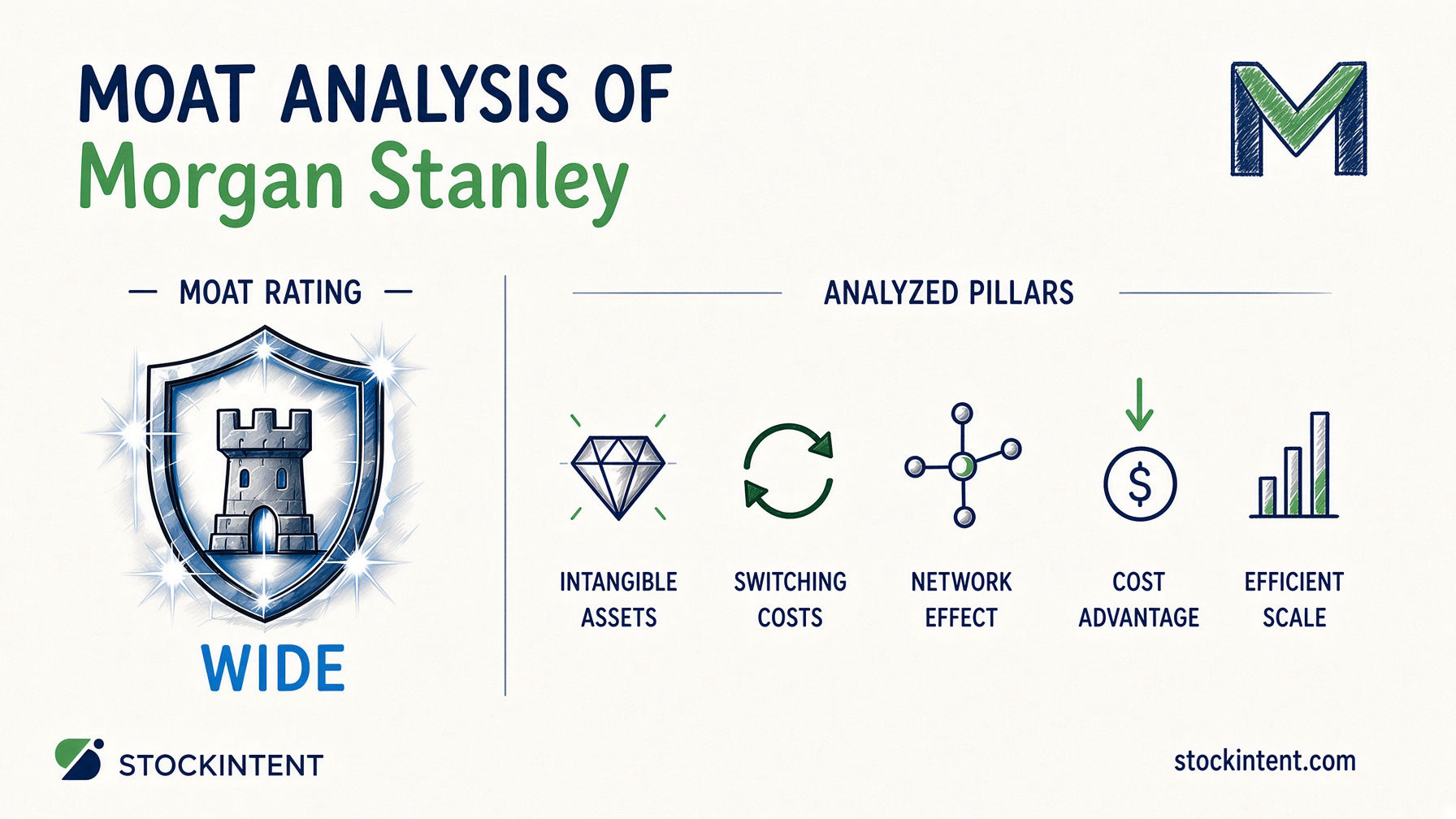
Morgan Stanley carries a Wide economic moat, upgraded from Narrow by Morningstar in 2026, with a Widening trend and High uncertainty rating.
Here's what matters most at a glance:
Pro Insight: A moat rating measures the durability of excess returns and business quality, not near-term stock performance or investment timing. Investors should separate the assessment of competitive strength from valuation and entry points.
In the sections that follow, we'll break down exactly which moat pillars hold up under scrutiny, where the evidence is thinner, and how to tell whether this widening trend is likely to continue.
Morgan Stanley's competitive position rests on a familiar five-pillar framework: switching costs, intangible assets, efficient scale, network effects, and cost advantage. Not all pillars are equally strong. We'll walk through each one in order of relevance, noting where the evidence is solid and where it falls short.
Switching Costs: Strong
The wealth management franchise is where Morgan Stanley's moat is deepest. Clients rarely hold just one product. They layer advisory accounts, brokerage relationships, lending facilities, financial planning, and custodial services into a single intertwined setup. Each additional product raises the friction of moving. Morgan Stanley's 2026 shareholder letter describes this as a deliberate shift toward durable, recurring-fee revenue. The firm's strategic update on the integrated firm model reinforces how multi-product relationships support retention and revenue stability across market cycles.
I've found this dynamic holds up in practice. Once a client has mortgages, tax planning, and concentrated stock management under one roof, the hassle of coordinating a transfer elsewhere becomes a quiet but powerful retention tool.
Intangible Assets: Moderate to Strong
Brand and franchise reputation matter enormously in financial services. Morgan Stanley's "elite brand" is an asset built over decades. Third-party analysis characterizes this intangible strength as a core differentiator in both wealth advisor recruitment and client trust. The evidence here is stronger for brand reputation than for any legally protected intangible like patents or exclusive licenses, which don't apply to this business.
Efficient Scale: Moderate
Scale shows up as operating leverage rather than classic efficient scale. Morgan Stanley spreads technology, compliance, and infrastructure costs across roughly $9.3 trillion in client assets and a global capital markets footprint. That's meaningful, but it's not the same as a market so limited that only a few players can profitably serve it. The firm's own strategic materials emphasize integration benefits more than scale-driven cost leadership.
Network Effects: Weak to Moderate
Here's where things get blurry. It's plausible that more clients attract more advisors, which improves deal flow, which attracts more clients. But none of Morgan Stanley's filings explicitly prove this loop. Available analysis notes only indirect evidence. Network effects may exist, but they're not a pillar I'd lean on heavily.
Cost Advantage: Weak / Not Material
Morgan Stanley simply doesn't compete on price. Company materials don't claim lower cost structures or structural price leadership versus peers. Scale supports efficiency, but that's different from a durable cost gap that would qualify as a moat pillar.
For investors who want to dig deeper into how these pillars show up in financial statements and rankings, reviewing detailed company reports can help ground the framework in actual data rather than narrative alone.
The strongest evidence of Morgan Stanley's moat appears in Wealth Management. In Q1 2026, the segment delivered record net revenues of $8.5 billion, a 30.4% pre-tax margin, $118 billion in net new assets, and $54 billion in fee-based flows. These aren't just impressive figures. They show a franchise that retains clients, attracts new ones, and converts scale into pricing power at a rate few peers can match.
That 30.4% margin matters. In my experience following financials, wealth management margins above 30% tend to signal genuine competitive advantage rather than temporary cost discipline. The $118 billion in net new assets reinforces this. Clients are actively bringing more capital to the platform.
Firmwide profitability tells a similar story. Morgan Stanley reported return on tangible common equity of 27.1% in Q1 2026 and 26.6% in Q2. Those figures sit well above most large-bank peers and suggest the business mix generates durable returns on equity capital.
Still, the moat's benefits aren't equally visible everywhere. Trading and investment banking revenue jumped 36% year-over-year in Q1 and 69% in Q2. These gains are real, but they reflect market activity at least as much as franchise strength. I've watched trading spikes reverse when volatility fades, so I treat these as evidence of operating capability rather than structural pricing power.
The gap between Wealth Management and Institutional Securities illustrates the central tension in Morgan Stanley's moat profile. One segment compounds. The other cycles. Investors should weigh that balance when judging how durable today's returns really are.
The moat is widening in our opinion.
That verdict rests on two converging signals. Morningstar's 2026 upgrade to Wide from Narrow reflects strengthening wealth management scale and a more integrated business model. The numbers back this up: Morgan Stanley grew from $20.6 billion in Q1 2026 net revenues to $21.35 billion in Q2, with return on tangible common equity holding above 26% in both quarters. Sequential momentum like this suggests the franchise is gaining ground, not just riding a market wave.
Wealth management is providing ballast with recurring fee revenue and sticky client relationships. Meanwhile, capital markets are recovering. Investment banking revenue rose 36% year-over-year in Q1 and equities trading jumped 69% in Q2. This combination of stability and cyclical upside is hard to replicate, and it's exactly what the integrated firm strategy was designed to produce.
But Morningstar kept its High uncertainty rating for a reason. Competitive position can strengthen even when the range of potential outcomes stays wide. The wealth management machine is impressive, yet execution risk in private markets integration, AI adoption, and regulatory navigation means the path from franchise strength to sustained excess returns isn't guaranteed.
What should investors actually watch? Here's our focus list:
The watchlist matters because moat trends don't announce themselves quarterly. They accumulate or erode based on choices management makes over years. Morgan Stanley's acquisition of EquityZen and its push to integrate private-market access into wealth workflows are moves that, if executed well, could widen the gap between the firm and peers who lack comparable scale or distribution density.
Still, I've seen enough strategic bets falter to remain cautious. The wealth management engine is clearly compounding. Whether the institutional side can maintain its recovery, and whether AI investments translate to advisor productivity rather than just cost, will determine if this widening trend persists or plateaus.
Our uncertainty rating for Morgan Stanley is High.
This isn't a knock on the business. It's a recognition that even strong franchises face a wide range of possible outcomes when capital markets cyclicality, regulatory risk, and execution challenges all press at the edges. Morningstar captured this nuance perfectly: they upgraded the moat to Wide in 2026 while keeping uncertainty High. Competitive position strengthened, but earnings predictability didn't follow in lockstep.
Three drivers keep the uncertainty rating elevated.
Revenue cyclicality. Wealth management provides a stabilizing core, yet trading and investment banking still swing total results. Q2 2026 delivered a 69% year-over-year jump in equities trading revenue, per CNBC's earnings coverage. That's genuine operating capability, but it's also genuine market dependency. When volatility fades or deal flow dries up, these gains can unwind just as fast. I've watched similar spikes reverse in prior cycles, and it teaches you to separate skill from conditions.
Regulatory risk. As a globally systemically important financial institution, Morgan Stanley faces evolving capital rules, supervisory intensity, and conduct scrutiny. The Q1 2026 SEC filing doesn't flag acute regulatory stress, but the broader context for large banks is one of heightened expectations, not relaxed ones. Rule changes can compress returns or redirect capital without warning.
Execution risk in AI and private markets. Morgan Stanley is investing heavily in advisor-facing AI and integrating alternative investment access into wealth workflows. These are promising directions, but technology transformations in financial services have a habit of delivering cost overruns and adoption gaps before they deliver productivity gains. The outcome range here is genuinely uncertain.
So where does this leave the 3-to-5-year outlook? The plausible range is moderately wide. The bull case says wealth management continues compounding, client assets push toward $10 trillion, and capital markets maintain a supportive backdrop. The bear case says trading normalizes, regulatory costs bite, and AI investments fail to convert into measurable advisor productivity.
For investors, the practical response is monitoring, not forecasting. The four indicators we flagged earlier, net new assets, wealth margins, AI adoption, and private-market penetration, are exactly what we track when building conviction over time.
If you want to organize metrics for Morgan Stanley and its peers, StockIntent's watchlist feature lets you set up ongoing monitoring.
Morgan Stanley earns a Wide economic moat with a Widening trend and High uncertainty. The upgrade from Narrow in 2026 reflects real structural improvement.
The evidence is clearest in wealth management. $118 billion in net new assets and pre-tax margins above 30% show switching costs doing what durable moats do: retaining clients, attracting capital, and converting scale into pricing power. Firmwide returns on tangible common equity above 26% in both Q1 and Q2 2026 confirm the integrated firm model is generating capital-efficient profits.
The tension hasn't disappeared. Trading and investment banking remain cyclical, and that cyclicality won't vanish regardless of how strong the wealth franchise becomes. Execution in AI adoption, private-market integration, and regulatory navigation will determine whether this widening trend persists or stalls.
For long-term investors, the question isn't whether Morgan Stanley has competitive advantages. It's whether management can compound those advantages faster than market and regulatory headwinds erode them.
This content is for informational or educational purposes and is not investment advice.
Start your 7-day free trial and find quality compounders faster.
— StockIntent Score ╌ S&P 500