Aug 27, 2026
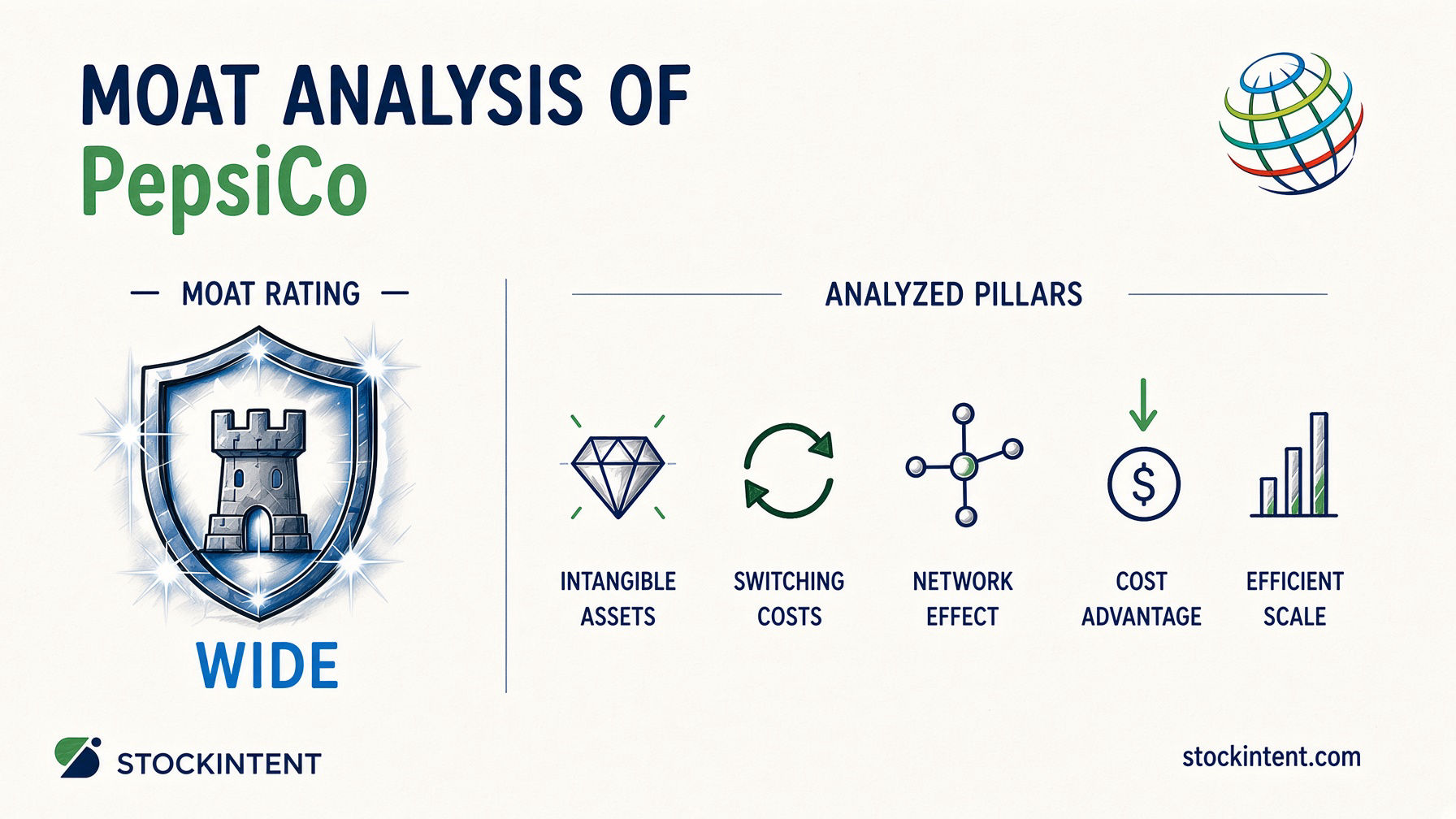
PepsiCo earns our Wide Moat rating, driven primarily by its intangible assets and efficient global scale. The moat trend is Stable, though execution over the next several quarters will decide whether it stays that way or shifts in either direction. We assign a Medium uncertainty rating, reflecting a business with durable strengths but real questions about pricing power limits and input cost volatility.
Here is the short version for investors who want the headline before the details:
Quality matters more than cheapness in our framework, so our verdict rests on whether PepsiCo's competitive advantages can sustain excess returns over time, not whether the stock looks inexpensive today. The moat is real, but it demands active management rather than passive compounding.
PepsiCo's moat is built on brands and distribution, not on network effects or switching barriers. Of the five classic moat pillars, two are genuinely strong for PepsiCo, one is moderate, and two are weak or not material to its business model.
PepsiCo's most defensible pillar is its portfolio of recognized brands and franchise-related rights. The company's Q2 2026 10-Q filing shows approximately $33.1 billion in indefinite-lived intangible assets. These include brands like Lay's, Doritos, Gatorade, and Pepsi itself, plus reacquired franchise rights that strengthen its direct control over distribution.
That figure matters because it represents capitalized economic value that PepsiCo can defend. Competitors can launch new flavors or imitate packaging, but matching the combined recognition, trust, and shelf access of decades-old brands requires sustained advertising spend that most rivals cannot replicate profitably.
PepsiCo operates a massive global system spanning both snacks and beverages. It holds leading positions in global savory snacks, U.S. salty snacks, U.S. carbonated soft drinks, and U.S. sports drinks as of 2026. The shared supply chain, manufacturing footprint, logistics network, and retailer relationships spread fixed costs across a revenue base that smaller entrants cannot match.
In categories where shelf presence and distribution density win, this scale is a genuine barrier. A new competitor cannot simply build parallel retail relationships overnight.
The company is actively reducing costs through plant closures, SKU simplification, and productivity programs. These efforts show operational discipline, but they also reveal something important: scale helps, yet input cost inflation, transportation, and labor expenses remain exposed to market volatility. Management must actively manage costs rather than inheriting them passively.
Consumers face almost no friction when switching from PepsiCo products to alternatives. Your grocery cart can just as easily hold Coca-Cola instead of Pepsi, or store-brand chips instead of Lay's. Any stickiness comes from habit, shelf presence, and brand preference, not from real switching barriers that would lock customers in.
PepsiCo's products do not become more valuable to you simply because more people consume them. There is no self-reinforcing user network here. This pillar is simply a poor fit for the consumer packaged goods business model, and we do not consider it relevant to the moat assessment.
Bottom line: The moat is brand and distribution, period. The twin strengths of intangible assets and efficient scale give PepsiCo durable advantages, but the moderate cost advantage requires active defending, and the weak switching costs remind us that consumer loyalty has limits.
PepsiCo's competitive advantages are most visible in its pricing power and margin resilience. In Q1 2026, the company delivered a 16.5% operating margin alongside 8.5% net revenue growth. These figures suggest the moat is converting into real economics, not just theoretical brand value.
Volume recovery is the critical stress test. Snack price cuts on major brands helped North American food volumes return to growth after more than two years of decline, with retailers expanding shelf presence. Q2 2026 then brought the fastest volume growth across foods and beverages since 2022. This is encouraging, but also revealing: PepsiCo needed price concessions to get volume back.
Our interpretation? The moat is intact but not immune to consumer pushback. Pricing power exists, yet it has limits that management must actively navigate.
Versus Coca-Cola, the comparison is instructive. Morningstar notes that Coca-Cola holds a cleaner single-category beverage moat, while PepsiCo benefits from broader diversification across snacks and beverages. PepsiCo's portfolio breadth adds resilience, though it may lack Coca-Cola's concentrated branding power in any one category.
For investors reviewing detailed financial metrics to test whether competitive advantages hold up in the numbers, the key signal is consistency: can revenue growth convert to earnings without repeated pricing concessions? Evidence improves our confidence without removing the uncertainty around whether volume recovery can sustain.
We classify PepsiCo's moat trend as Stable, but the next few quarters will determine whether it edges wider or narrows. The company has demonstrated real volume recovery and revenue resilience, yet uneven profit conversion and a promotional environment create genuine questions about whether recent gains are durable or just borrowed through price cuts.
The positive signals are meaningful. In Q2 2026, PepsiCo delivered $24.18 billion in revenue, beating estimates. Management highlighted the fastest volume growth across foods and beverages since 2022. That's a genuine recovery after more than two years of volume pressure.
Still, the caution lights are on. The same quarter brought adjusted EPS of $2.20, just below the $2.21 forecast, and management struck a cautious tone on full-year profits. Shares fell premarket. Revenue growth is not automatically good news if it requires more promotion, lower pricing, or higher trade spending to achieve.
Pro Insight: Volume recovery after tactical price cuts is a critical stress test for moat durability. It reveals whether pricing power was temporarily stretched or permanently damaged. The speed of volume return in Q2 2026 suggests the moat is intact but not immune to consumer trade-down behavior.
The competitive field is not standing still. Porter's Five Force analysis identifies Coca-Cola, Monster, Keurig Dr Pepper, and Mondelez as active pressure points across beverages and snacks. Private labels and niche brands are also chipping away on price and novelty. PepsiCo's diversification across snacks and beverages provides a buffer that Coca-Cola lacks, but it also means the company is fighting on multiple fronts simultaneously.
Management's 2026 guidance frames the execution challenge. The company targets 2% to 4% organic revenue growth and 4% to 6% core constant-currency EPS growth. Hitting the upper half of both ranges would suggest the moat is widening. Falling toward the lower end, or missing EPS while revenue holds, would signal that competitive advantages are not translating into financial outperformance.
Investors watching PepsiCo should monitor these four indicators to judge whether the moat trend is improving or weakening:
Patience is an edge here. Single quarters can mislead. The real signal comes from watching whether volume recovery sustains without perpetual pricing concessions, and whether the company can convert that volume into the 4-6% EPS growth management has promised.
We assign PepsiCo a Medium uncertainty rating. The business is durable, but the range of future outcomes is wider than a pure defensive staples narrative would suggest.
Four factors drive this rating. First, operating costs remain volatile. The Q2 2026 10-Q filing explicitly warns that commodity, transportation, and labor costs are exposed to market swings, tariffs, adverse weather, supply-chain disruptions, and geopolitical conditions. PepsiCo uses hedging and pricing to manage this, but margins can still be impacted.
Second, geographic diversification cuts both ways. International markets contribute 43% of consolidated net revenue, which supports resilience but adds currency translation risk and geopolitical exposure including ongoing operations in Russia and Middle East disruption noted in the same filing.
Third, competitive pressure is intensifying. Porter's Five Force analysis flags Coca-Cola, Monster, Keurig Dr Pepper, and Mondelez as active threats across beverages and snacks. Private labels are also gaining shelf space on price. The moat must be actively defended; it does not defend itself.
Fourth, execution risk in North America is real. Management has outlined a turnaround plan for 2026, but analysts want clearer proof that innovation and productivity can restore organic growth momentum rather than simply stabilize declines.
The offsetting factor is cash flow stability. PepsiCo plans to return approximately $8.9 billion to shareholders in 2026, a figure that reflects confidence in underlying free cash generation even as margins fluctuate. That payout capacity matters for moat durability, but it does not eliminate the operational and competitive risks that widen our outcome range.
Over the next three to five years, we see a band from "steady staple with improving growth" to "still strong, but slower growth and more pressure on returns than expected." The moat is unlikely to collapse, but its durability is execution-dependent rather than automatic. Historical performance and moat assessments do not guarantee future results, and this uncertainty rating reflects that range of possibilities rather than a prediction.
PepsiCo carries our Wide Moat rating with a Stable trend and Medium uncertainty. The moat rests on two durable pillars: approximately $33.1 billion in indefinite-lived intangible assets and unmatched global distribution scale across snacks and beverages. These advantages are real, but they require active management rather than passive compounding.
The critical question ahead is whether volume recovery can sustain without continued pricing concessions. Q2 2026 showed the fastest volume growth since 2022, which is encouraging. Yet the same quarter brought a small EPS miss and cautious profit guidance, a reminder that the moat does not guarantee smooth earnings conversion.
For investors applying this framework to their own research, reviewing detailed financial metrics is the natural next step. The four indicators we identified, organic revenue growth, volume versus price composition, category share trends, and EPS consistency, provide a practical watchlist for testing whether PepsiCo's competitive advantages hold up in the numbers over time.
This assessment offers transparent frameworks, assumptions, and reasoning rather than confident predictions. The moat is likely durable, but your judgment should update as subsequent quarters reveal whether recovery is sustainable or merely borrowed.
Start your 7-day free trial and find quality compounders faster.
— StockIntent Score ╌ S&P 500