Aug 31, 2026
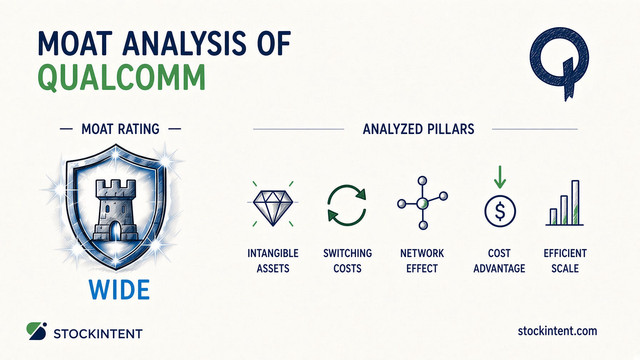
Qualcomm earns a Wide economic moat in our assessment, with a Stable-to-widening trend and Medium uncertainty. The evidence is strikingly split: its licensing unit routinely delivers earnings before tax margins near 70%, while its core handset chip business is losing share to rivals like MediaTek.
In Q1 FY2026, Qualcomm posted record revenue of $12.3 billion, right at the high end of guidance. Yet smartphone chipset share slipped from 27% to 23% year over year, and Apple-related revenue is falling fast.
Here's the tension in a nutshell: Qualcomm's patent-licensing fortress prints money, but the castle still sits on a shrinking hill of handset silicon.
Quick takeaways
We think the moat is real, but uneven. The sections below walk through each pillar, show where the competitive advantages actually show up in performance, and explain what could strengthen or erode them from here.
We assess Qualcomm through the five classic moat pillars: intangible assets, switching costs, network effects, efficient scale, and cost advantage. Not all pillars matter equally for every business. Here's where Qualcomm actually derives its competitive protection.
Intangible assets: Strong. This is Qualcomm's clearest and most durable advantage. The company's patent portfolio and participation in wireless standards create licensing economics that few rivals can replicate. In Q1 FY2026, the QTL licensing segment delivered a 77% earnings-before-tax margin on roughly $1.6 billion in revenue. That figure moderated to 72% in Q2 and 69% in Q3, but still represents exceptional structural pricing power. These margins reflect what happens when standards-essential patents meet global device adoption: Qualcomm can extract royalties without bearing the cyclicality of unit manufacturing.
Expert Tip: Cost advantage is the most misunderstood moat pillar in semiconductor analysis. For IP-heavy businesses like Qualcomm, the moat derives from pricing power in standards-essential patents, not manufacturing scale
Switching costs: Strong to moderate. Qualcomm's chipsets and modems embed deeply into handset and automotive design roadmaps. The company's SEC filings disclose substantial revenue concentration among a limited set of customers, which cuts both ways. It reveals customer lock-in: once a manufacturer qualifies a Qualcomm modem and RF solution for a device generation, swapping suppliers burns engineering time, certification cycles, and carrier relationships. But concentration also means Qualcomm is vulnerable to deliberate exits, as we're seeing with Apple.
Efficient scale: Moderate. The company's $45 billion automotive design-win pipeline demonstrates that Qualcomm can spread massive R&D investments across growing end markets. In cellular standards and licensing, the scale economics are genuinely impressive: fixed patent-maintenance and standards-participation costs distribute across billions of devices. Still, efficient scale is less convincing in competitive chip markets where MediaTek and others hold comparable manufacturing capacity.
Network effects: Moderate. Qualcomm benefits from ecosystem reinforcement. Broad OEM adoption, carrier compatibility testing, and standards participation make Qualcomm-compatible solutions incrementally more valuable for the next device generation. But this isn't a consumer platform network effect. The dynamic is indirect and weaker than what you'd see in marketplaces or social networks.
Cost advantage: Weak and not material. Here's the honest assessment: Qualcomm does not compete on production cost. Its filings explicitly note customer bargaining power and pricing pressure. The business model depends on high-value IP and integration, not lowest-cost manufacturing. Any R&D scale benefits belong more to intangible assets and efficient scale than to pure cost leadership.
If you want to run similar pillar-by-pillar assessments for other holdings, StockIntent company reports let you evaluate individual moat pillars alongside financial health metrics and competitive positioning data in one workflow. We find it helps keep the analysis disciplined rather than defaulting to "great company" intuition.
Qualcomm's competitive advantages translate into real profits, but not evenly across every division. The moat is clearest in licensing economics, promising in automotive, and under pressure in handsets.
Licensing is the star witness. QTL margins of 77% in Q1, 72% in Q2, and 69% in Q3 FY2026 demonstrate structural pricing power that transcends product cycles. We're talking about margins that most manufacturers can only dream of. This is what happens when standards-essential patents meet global device adoption; Qualcomm collects royalties regardless of which brand sells the phone.
Automotive momentum validates platform extension. Revenue surged from $1.1 billion in Q1 to $1.6 billion in Q3 FY2026, with year-over-year growth accelerating from 15% to 61%. The numbers suggest Qualcomm's compute and connectivity stack is winning content per vehicle and deepening OEM relationships.
Handsets remain the Achilles' heel. Handset revenue declined 13% in Q2 FY2026, and smartphone chipset share compressed from 27% to 23% year over year. The segment is still large, about $5.1 billion in Q3, but cyclicality and competitive pressure from MediaTek mean this is share retention, not moat widening.
In our experience analyzing semiconductor economics, licensing margins above 70% represent rare structural pricing power. But investors must distinguish between the durability of the IP portfolio, which is strong, and the cyclicality of handset volumes, which remains an ongoing risk. The true moat lies in the royalty economics, not the unit shipments.
The verdict here is stable-to-widening, but there's a catch: it depends entirely on execution. Qualcomm is actively rewiring its competitive position from a handset-centric chipmaker into a diversified compute platform spanning automotive, PCs, and IoT. Whether that transition cements a wider moat or leaves Qualcomm stranded in a shrinking core market will be decided over the next three to five years.
Widening forces are real and accelerating. Automotive revenue climbed from $1.1 billion in Q1 FY2026 to $1.6 billion in Q3, with year-over-year growth surging from 15% to 61%. The company reports a $45 billion automotive design-win pipeline and expects to exit FY2026 above a $6 billion annualized auto revenue run rate. Management also expects non-handset revenue to accelerate more than 60% in FY2027. The platform approach in vehicles (connectivity, cockpit, ADAS integration) suggests rising switching costs as OEMs embed Qualcomm deeper into their architectures.
Stable or weakening forces remain stubbornly relevant in the core business. Smartphone chipset share fell from 27% in Q1 2025 to 23% in Q1 2026, while MediaTek leads at 32%. Handset revenue declined 13% in Q2 FY2026. More critically, Apple-related revenue is experiencing "sharp declines", demonstrating that even historically entrenched relationships can erode when a customer builds its own solution.
Here's the tension that defines this trend: Qualcomm's new growth engines run on design wins with multi-year conversion cycles, while its legacy franchise faces near-term share erosion. The question isn't whether automotive momentum is genuine (it is), but whether it scales fast enough to offset handset pressure and replicate anything close to licensing-grade economics.
What to monitor. We think investors should track four measurable indicators:
If you're tracking these metrics across multiple holdings, StockIntent watchlists let you organize them into a persistent monitoring system. We find it useful for forcing periodic reality checks against the original thesis, especially when a story depends on execution over years rather than quarters.
We rate Qualcomm's moat uncertainty as Medium. The licensing business is a fortress, but the walls are thinner than they first appear. Three forces keep the range of plausible outcomes reasonably wide: customer concentration risk, revenue cyclicality, and execution uncertainty in new markets.
Customer concentration is the most immediate concern. Qualcomm's SEC filings acknowledge that a significant portion of revenue comes from a small number of customers and licensees. In the Q3 FY2026 earnings call, management cited "sharp declines" in Apple-related revenue, confirming that even long-standing partnerships can unwind quickly. When your best customers can build their own chips, the predictability of future royalties gets harder to model.
Revenue cyclicality persists despite diversification efforts. Memory constraints, China OEM inventory swings, and Android launch timing still drive quarter-to-quarter volatility. For Q4 FY2026, Qualcomm guided revenue between $9.7 billion and $10.5 billion, a range wide enough to signal genuine demand uncertainty. The 10-Q also notes gross margin pressure in Q3 from lower QCT handset profitability, which means headline licensing strength doesn't fully insulate operating results.
Execution risk in automotive, AI PCs, and data center keeps the long-term picture unsettled. The $45 billion automotive design-win pipeline is impressive on paper, but converting design wins to licensing-grade margins requires sustained R&D, ecosystem investment, and OEM platform lock-in over multiple years. These are solvable problems, but they are not yet solved.
So what does Medium uncertainty mean in practice? The core IP portfolio's durability is fairly predictable. What's harder to judge is whether Qualcomm's newer platforms can replicate that economics before handset cyclicality erodes overall returns. The range of outcomes isn't extreme, but it's wide enough that patient monitoring matters more than conviction.
Qualcomm earns a Wide economic moat with a Stable-to-widening trend and Medium uncertainty. The licensing business remains the foundation: QTL margins averaged roughly 70% across FY2026, producing structural pricing power that most semiconductor companies simply cannot replicate. At the same time, automotive revenue reached $1.6 billion in Q3, up 61% year over year, and management is targeting $40 billion in non-handset revenue by fiscal 2029.
The decisive issue is timing, not possibility. Smartphone chipset share has already compressed from 27% to 23%, and Apple-related revenue is declining sharply. Qualcomm's newer platforms must scale before handset cyclicality erodes overall returns. We think the moat is durable, but transition-dependent. Investors should size positions accordingly and monitor automotive execution against that $40 billion target rather than treating the handset decline as a temporary blip.
Start your 7-day free trial and find quality compounders faster.
— StockIntent Score ╌ S&P 500