Aug 28, 2026
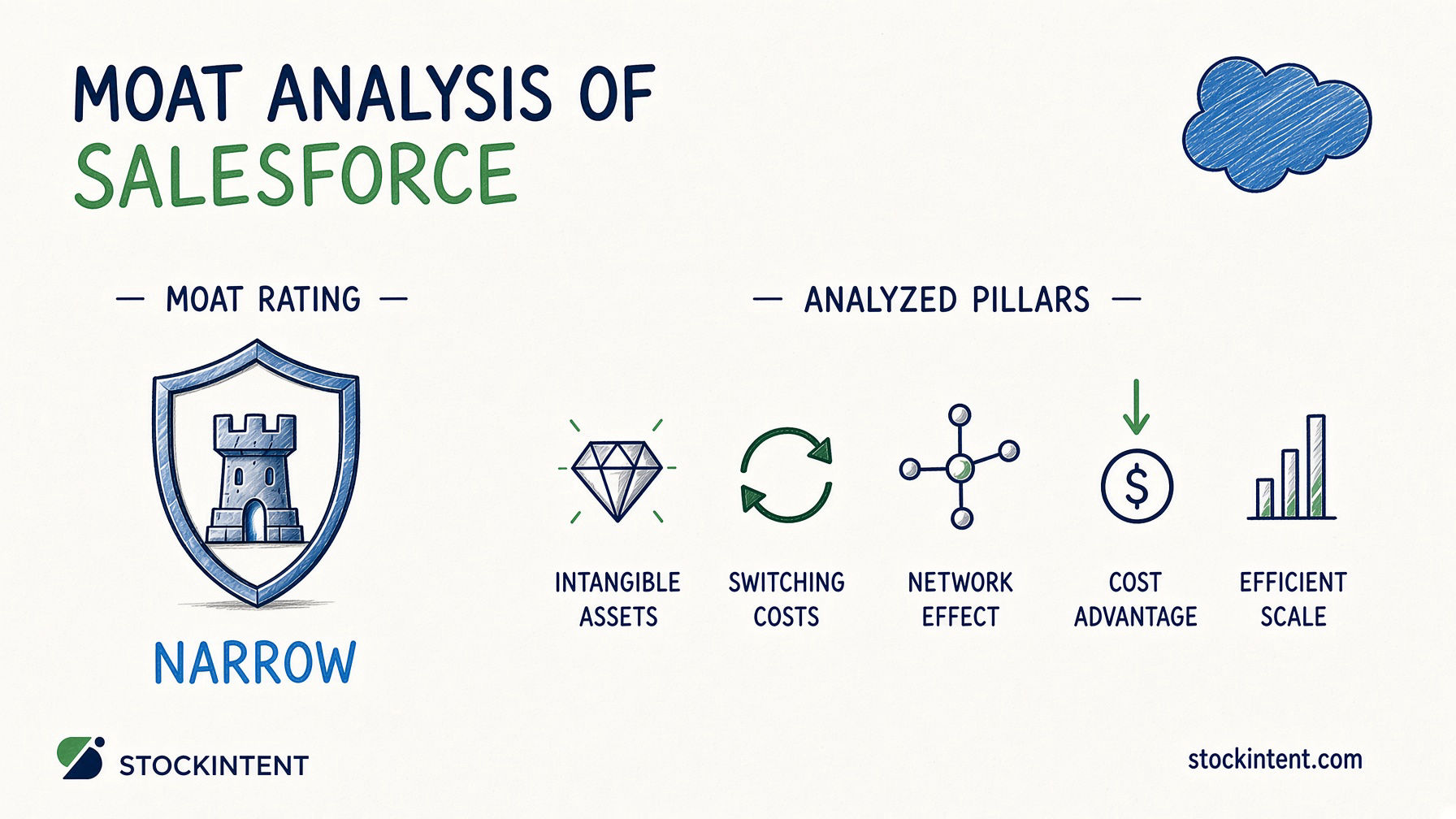
Salesforce carries a Narrow moat rating as of 2026, following a Morningstar downgrade from Wide due to AI disruption concerns. The moat trend is Stable, with Medium uncertainty. The business still generates durable economics, but the long-term durability of its competitive advantages is under pressure.
Here's what matters most for investors:
The moat assessment here is about business quality and durability of excess returns, not whether the stock is cheap or expensive today. Salesforce's FY26 operating cash flow of $15.0 billion and GAAP operating margin of 20.1% demonstrate real economic power.
The question is whether that power persists as AI reshapes how enterprises buy and use CRM software.
Salesforce is fundamentally a switching-cost story with secondary ecosystem network effects. The five moat pillars matter very differently here; two are genuinely strong, one is present but modest, and two barely register. Here's how we see each one as of 2026.
This is Salesforce's most durable advantage. The platform sits inside customer workflows, data integrations, and user training across sales, service, and platform operations. Morningstar's software moat research explicitly identifies switching costs as the primary moat source, and the evidence backs that up. Approximately 92% annual customer retention and a $72.4 billion total RPO demonstrate that enterprise customers don't walk away lightly. Replacing Salesforce means rebuilding integrations, retraining teams, and migrating data; that friction protects recurring revenue even when competitors look attractive on price.
Pro Insight: Salesforce's switching costs are real but evolving. The moat is narrowing not because customers can easily leave today, but because AI agents may eventually reduce the friction of migration by automating the transfer of workflows and data that currently create stickiness. Investors should watch whether Agentforce increases lock-in or merely defends against commoditization.
The AppExchange ecosystem and large partner base do create platform value, but these are indirect ecosystem effects, not the direct network effects you see in consumer marketplaces. More developers make Salesforce more useful, which attracts more customers, which draws more developers. Still, this depends heavily on continued platform relevance. If AI tools make it easier to build workflow applications outside Salesforce's orbit, the ecosystem advantage thins out.
Salesforce enjoys strong brand recognition in CRM, which helps selling and customer trust. Morningstar's analysis notes this modest contribution. But brand alone doesn't block competition the way proprietary IP or regulatory licenses might. Microsoft, Oracle, and newer entrants can build comparable products without infringing Salesforce's intangible position. We see the brand as a tailwind, not a fortress.
Salesforce operates at solid margins, but that's pricing power from switching costs, not structural cost leadership. KoalaGains' business analysis and competitive context both point to the same conclusion: rivals like Microsoft can bundle CRM with cloud infrastructure and productivity suites, undermining any claim to a durable cost edge. Salesforce doesn't win on being cheaper to run.
CRM is not a natural monopoly. Multiple competitors coexist profitably at scale, and Salesforce's size helps but doesn't create an insurmountable barrier. The market has room for Microsoft, Oracle, HubSpot, and others. Scale is an asset, not a moat pillar here.
One more layer matters: moat strength isn't uniform across Salesforce's portfolio. Morningstar's 2026 assessment rates Sales Cloud, Service Cloud, and the Salesforce Platform as wide-moat franchises, while Marketing Cloud, Commerce Cloud, and Data Cloud carry narrower competitive positions. The core CRM engine is more defensible than the expansion products. That product-line variance is worth tracking as AI investment gets allocated across the portfolio.
Salesforce's moat is most visible in its contracted backlog and margin structure, less visible in accelerating market share. The $72.4 billion total RPO, up 14% year-over-year, demonstrates sticky enterprise commitments and unusually strong revenue visibility. That backlog represents customers who have already signed contracts but not yet recognized revenue; they can't easily walk away without disruption.
Profitability metrics reinforce the story. FY26 non-GAAP operating margin reached 34.1%, up 110 basis points from the prior year, while GAAP operating margin hit 20.1%. Expanding margins while growing FY26 revenue to $41.5 billion (10% growth) suggests pricing power and operating leverage, not just cost cutting. Operating cash flow of $15.0 billion shows the economics convert to actual cash.
Customer behavior confirms the stickiness. Approximately 92% annual customer retention means the installed base largely stays put. That retention, combined with RPO growth, is the clearest signal that switching costs are working as intended.
Still, the moat shows cracks in specific areas. Global CRM market share sits at roughly 22.5%, characterized as stable to slightly declining rather than expanding. Leadership is real, but dominance isn't deepening. Pricing power is also harder to isolate; margin expansion could reflect cost discipline as much as the ability to raise prices without pushback.
The weakest visible link is AI monetization. Agentforce and Data 360 are growing, but the data don't yet prove they've become durable, high-margin contributors rather than early-cycle growth drivers. The moat is observable in retention and profitability, not necessarily in share gains or proven AI economics.
Salesforce's moat trend is Stable-to-slightly-widening as of 2026. The business isn't eroding, but the next phase of competitive advantage depends heavily on whether AI deepens customer lock-in or simply raises the baseline for everyone.
Several signals support stability. Management raised FY27 revenue guidance to $45.8–$46.2 billion and set a FY30 target of $63 billion including Informatica, which suggests confidence in continued platform expansion. The $72.4 billion total RPO, up 14% year-over-year, provides unusually strong forward revenue visibility. Agentforce traction and Data Cloud adoption could, if sustained, create a new layer of workflow automation that makes the platform harder to leave.
Still, there are real pressures. The enterprise software market is shifting from "systems of record" to "systems of action" driven by AI and agentic workflow automation, which changes how buyers evaluate CRM platforms. Morningstar's 2026 downgrade reflects this structural concern: if AI features become table stakes and Salesforce fails to differentiate, customers may view CRM vendors as more interchangeable, directly threatening the switching-cost pillar that protects the franchise. Microsoft's bundling strategy and Oracle's enterprise push remain persistent competitive threats, while regional weakness in the UK and Japan markets shows demand isn't uniformly strong everywhere.
Market share tells a similarly mixed story. At roughly 22.5% of global CRM, Salesforce remains the category leader, but that share is characterized as stable to slightly declining rather than expanding. The question isn't whether Salesforce is dominant today; it's whether that dominance can be defended as AI changes buying criteria and workflow design.
Here's what we'd track to judge whether the trend is improving or weakening over the next three to five years:
We rate Salesforce's moat uncertainty as Medium. The business has genuine stabilizers that limit extreme outcomes, but several execution and transition risks create a range of futures wide enough to matter for long-term investors.
On the stabilizing side, roughly 95% of revenue comes from subscriptions, which smooths cash flows and makes revenue reasonably predictable even when macro conditions soften. The $72.4 billion total RPO provides unusually strong forward visibility, and FY26 GAAP operating margin of 20.1% demonstrates that profitability has structural support. These factors make a competitive collapse unlikely over a three-to-five-year horizon.
Still, four risks widen the outcome range meaningfully. AI execution risk tops the list: if Agentforce and Data Cloud become table stakes rather than differentiated lock-in tools, customers may start viewing CRM vendors as interchangeable, directly eroding the switching-cost pillar. Informatica integration risk adds near-term execution uncertainty around whether the acquisition enhances platform stickiness or merely dilutes focus and margins. Product mix risk shows up in ongoing weakness in Marketing and Commerce Clouds, where competitive pressure is sharper than in core CRM. Regional risk is visible in underperformance across the UK and Japan, reminding investors that Salesforce isn't insulated from local demand softness or geopolitical friction.
The range of plausible outcomes is moderately wide. Core CRM durability and recurring revenue limit the downside; the AI transition and product-mix shifts create meaningful dispersion in upside versus downside scenarios. Investors watching this story should track whether organic growth accelerates independently of acquisitions, whether RPO and current RPO keep expanding, and whether net retention in enterprise accounts improves as AI products deepen engagement.
For investors who want to monitor these evolving fundamentals over time, StockIntent's company reports provide a structured way to track financial statements, metric rankings, and competitive positioning as the uncertainty resolves.
Salesforce earns a Narrow moat rating as of 2026, down from Wide following a Morningstar downgrade driven by AI disruption concerns. The trend is Stable, with Medium uncertainty. The competitive advantages remain economically meaningful, but their long-term durability is under pressure from structural industry shifts.
Two issues matter most for investors watching from here. First, whether AI products like Agentforce create new layers of data-and-automation lock-in, or merely defend against commoditization by raising the competitive baseline. Second, whether the Informatica integration enhances platform stickiness without diluting margins or distracting execution.
The evidence for the moat is real: approximately 92% annual retention, $72.4 billion in total RPO, and non-GAAP operating margin of 34.1% all demonstrate that switching costs currently protect the franchise.
The open question is whether that protection persists as AI reshapes how enterprises evaluate, deploy, and potentially migrate between CRM platforms.
Start your 7-day free trial and find quality compounders faster.
— StockIntent Score ╌ S&P 500