Aug 29, 2026
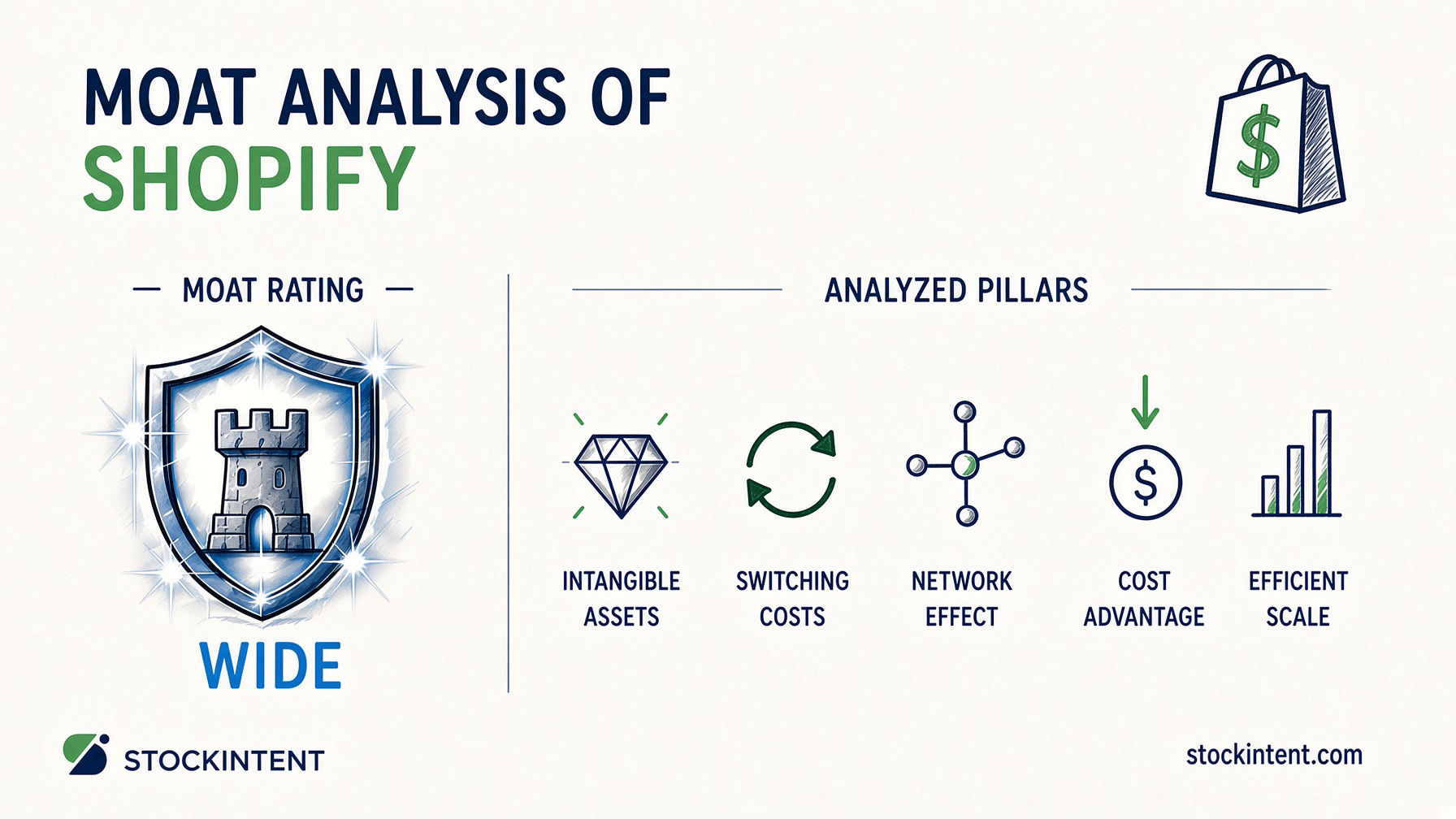
Shopify carries a wide economic moat driven by switching costs and network effects, with a widening trend as the platform embeds deeper into merchant operations, and a medium uncertainty rating because AI durability and revenue mix risks could shift the story faster than investors expect.
Here's the snapshot for busy readers:
In the sections ahead, we'll walk through each moat pillar, show where the advantages show up in actual business performance, and flag the specific developments that could strengthen or erode this assessment over the next few years.
We evaluate Shopify through the five classic moat pillars, ordered from strongest to weakest. This approach keeps the analysis concrete and helps investors see where the real durability lives versus where the story gets fuzzy.
Switching Costs: Strong. Shopify's merchants don't just use software; they embed workflows across payments, shipping labels, capital advances, POS hardware, and app integrations. The more tools a merchant adopts, the more disruptive migration becomes. In Q2 2026, Shopify Payments handled 68% of global GMV, up from roughly 64% a year earlier. Retention rates tell the same story: 92% for merchants above $1M GMV and 97% for merchants above $10M GMV. These indicate locked-in operators whose entire business nervous system runs on Shopify rails.
Network Effects: Strong. More merchants attract more app developers, agencies, and service partners, which makes the platform more valuable for the next merchant. It's a classic two-sided flywheel, and the scale is now genuinely large. Q2 2026 GMV hit $115.6 billion, up 32% year over year, with five consecutive quarters above 30% growth. That volume funds ecosystem depth that new entrants simply cannot match quickly. Morningstar's 2026 Software Moat Report explicitly calls out switching costs and network effects as the backbone of Shopify's wide moat assessment.
Intangible Assets: Moderate. Shopify's brand matters. Merchants trust it, and that trust compounds with scale. But here's the thing: this isn't patent-protected IP or regulatory exclusivity. Competitors can replicate the feature set, even if replicating the ecosystem trust takes years. The company's Q2 2026 filings show only modest amortization of acquired intangibles relative to business scale, which confirms that bought assets aren't the moat. The real intangibles are brand and reputation, helpful but not sufficient alone.
Cost Advantage: Weak to Moderate. Shopify spreads R&D and infrastructure across a massive merchant base, so there's clear scale efficiency in software delivery. But, and this matters, Merchant Solutions economics are heavily tied to payment-processing fees and other pass-through costs that rise with GMV. The Q2 2026 filings show revenue of $3.583 billion with growth that's impressive but not obviously cheaper-to-serve than peers at similar scale. There's no unique structural cost edge here.
Efficient Scale: Not Material. E-commerce software isn't a small, constrained market where one or two players naturally dominate. Merchants can and do choose from multiple platforms, point solutions, and custom builds. Shopify's advantage comes entirely from ecosystem depth and switching costs, not from market structure that prevents new competition. This is the weakest pillar by far in our opinion.
Pro Insight: Unlike railroads or regulated utilities, e-commerce software lacks structural constraints that create natural monopolies. Shopify's competitive defense depends on how deeply merchants embed in its ecosystem, not on industry structure limiting efficient competitors.
For investors who want to dig deeper into individual company moats, review financial statements, and test durability through fundamental data, StockIntent's company reports provide a structured workflow for this kind of analysis.
Shopify's competitive advantages aren't theoretical. They show up in hard numbers. In Q2 2026, the company reported $3.583 billion in revenue, up 34% year over year, with free cash flow margin around 18%. That's impressive. But the real signal is in the retention data: 92% for merchants above $1M GMV and 97% for merchants above $10M GMV. When businesses grow on Shopify, they tend to stay. That's switching costs in action.
Still, the moat has a soft spot. Merchant Solutions now drives faster growth than Subscription Solutions, and that matters because payments, shipping, and capital carry lower margins. Finsee's Q2 2026 review flags this mix shift explicitly: revenue looks great, but gross profit pressure is real. The platform is monetizing more deeply, just not always more profitably. For investors, that means the moat's durability depends partly on whether Shopify can stabilize profitability while continuing to grow share.
The market position remains strong, though exact share depends on who's counting. TechnologyChecker's 2026 analysis puts Shopify at 22-25% of global ecommerce platform share by one methodology, and a dominant 45.99% of platform-detected domains by another. Both point to leadership; neither proves unassailable dominance. Enterprise competition from Salesforce Commerce Cloud and Adobe Commerce keeps the pressure on, especially for technically complex, large-scale merchants.
Pricing power? Present but not absolute. Shopify can layer on services and raise attach rates, but broad price hikes without merchant pushback aren't clearly demonstrated in the 2026 data. The moat wins on retention and ecosystem breadth more than on brute-force pricing strength.
Shopify's moat is widening in our opinion.
The evidence runs across multiple dimensions, and it's hard to miss once you line up the numbers. In Q2 2026, Shopify reported $115.6 billion in GMV, up 32% year over year, marking five consecutive quarters above 30% growth. That's momentum, but momentum alone doesn't widen a moat. What's actually doing the work is how merchants are embedding Shopify deeper into their operations.
Shopify Payments penetration reached 68% of global GMV in Q2 2026, up from roughly 64% a year earlier. Every percentage point matters here. Payments aren't just revenue; they're switching costs in disguise. The more checkout flow, fraud protection, and working capital advances run through Shopify's rails, the more painful and costly migration becomes.
The expansion beyond core online storefronts is what's most telling. International GMV grew 37% year over year, B2B GMV surged 76%, offline and POS GMV climbed 32%, and Shop Pay GMV jumped 53%. They show merchants treating Shopify as a unified operating system across online, offline, wholesale, and global channels, not just a website builder. Digital Commerce 360 noted this shift explicitly in its Q2 2026 coverage. The U.S. e-commerce market share now sits above 14%, which suggests this embedding is translating into share gains rather than mere usage expansion.
But here's a wrinkle we keep coming back to: AI. Analysts increasingly view AI capabilities as potentially "table stakes" rather than durable differentiation. The features will likely spread across competitors. Shopify's edge, if it persists, depends on integration depth and data advantages rather than any single AI tool. Execution speed matters more than feature novelty here.
So what should investors actually watch? Here's our four-item checklist:
These indicators feeds directly into how confident we can be about the moat's durability, which brings us to our uncertainty assessment.
We rate Shopify's moat uncertainty as Medium. The competitive position looks durable, but several forces could widen the range of outcomes.
Four drivers keep us from calling this a low-uncertainty story. First, the revenue mix shift toward Merchant Solutions is diluting margins even as top-line growth impresses. Q2 2026 revenue hit $3.583 billion, up 34% year over year, yet gross profit grew slower than revenue because payments and shipping carry lower margin profiles than software subscriptions. Finsee's Q2 2026 review flags this explicitly, and management's Q3 2026 guidance for growth in the low 30% range implies the mix pressure isn't resolving soon.
Second, macro sensitivity is real and hard to hedge. Shopify's Q2 2026 filings cite risks from tariffs, cross-border trade measures, and consumer spending volatility. Merchants feel these first; Shopify feels them second. The platform isn't cyclical like a retailer, but it's not immune either.
Third, AI execution risk looms. Analysts in 2026 increasingly question whether Shopify's AI investments create structural advantage or simply maintain parity. Features like Sidekick are useful, but useful features spread fast in software. The moat here depends on integration depth and data scale, not any single AI release.
Fourth, credit and financing activities add volatility that pure SaaS models avoid. TradingKey's Q2 2026 analysis notes that merchant loans, advances, and transaction losses introduce earnings risk if loss rates rise. That's a different risk profile than subscription revenue alone.
What does this mean for the outcome range? We think Shopify likely remains a dominant commerce platform over three to five years, but the spread between strong and adequate outcomes is meaningful. The platform could compound its advantages through deeper embedding, or it could see margins compress and AI advantages commoditize. The base case is positive; the confidence interval is wider than we'd like.
For investors who want to track these uncertainty drivers over time, StockIntent watchlists let you organize Shopify alongside comparable companies and monitor the metrics that matter most for moat durability.
Shopify earns a wide economic moat rooted in switching costs and network effects, with a widening trend as merchants embed the platform deeper across payments, B2B, international, and offline channels. Its medium uncertainty rating reflects real risks that could shift the story faster than the headline growth suggests.
Two issues matter most from here. First, whether AI advantages remain structurally durable or devolve into table stakes. Features spread fast in software; Shopify's defense depends on integration depth and data scale, not any single tool. Second, whether Merchant Solutions growth can stabilize margins or will keep pressuring profitability. The 34% revenue growth in Q2 2026 looks strong, but gross profit growing slower than revenue is a signal worth watching.
What would change our view? Accelerating AI commoditization that erodes merchant switching costs, or a sustained gross margin collapse that proves deeper monetization isn't translating to durable economics. Our base case remains positive though.
This content is for informational and educational purposes only and is not investment advice.
Start your 7-day free trial and find quality compounders faster.
— StockIntent Score ╌ S&P 500