Sep 1, 2026
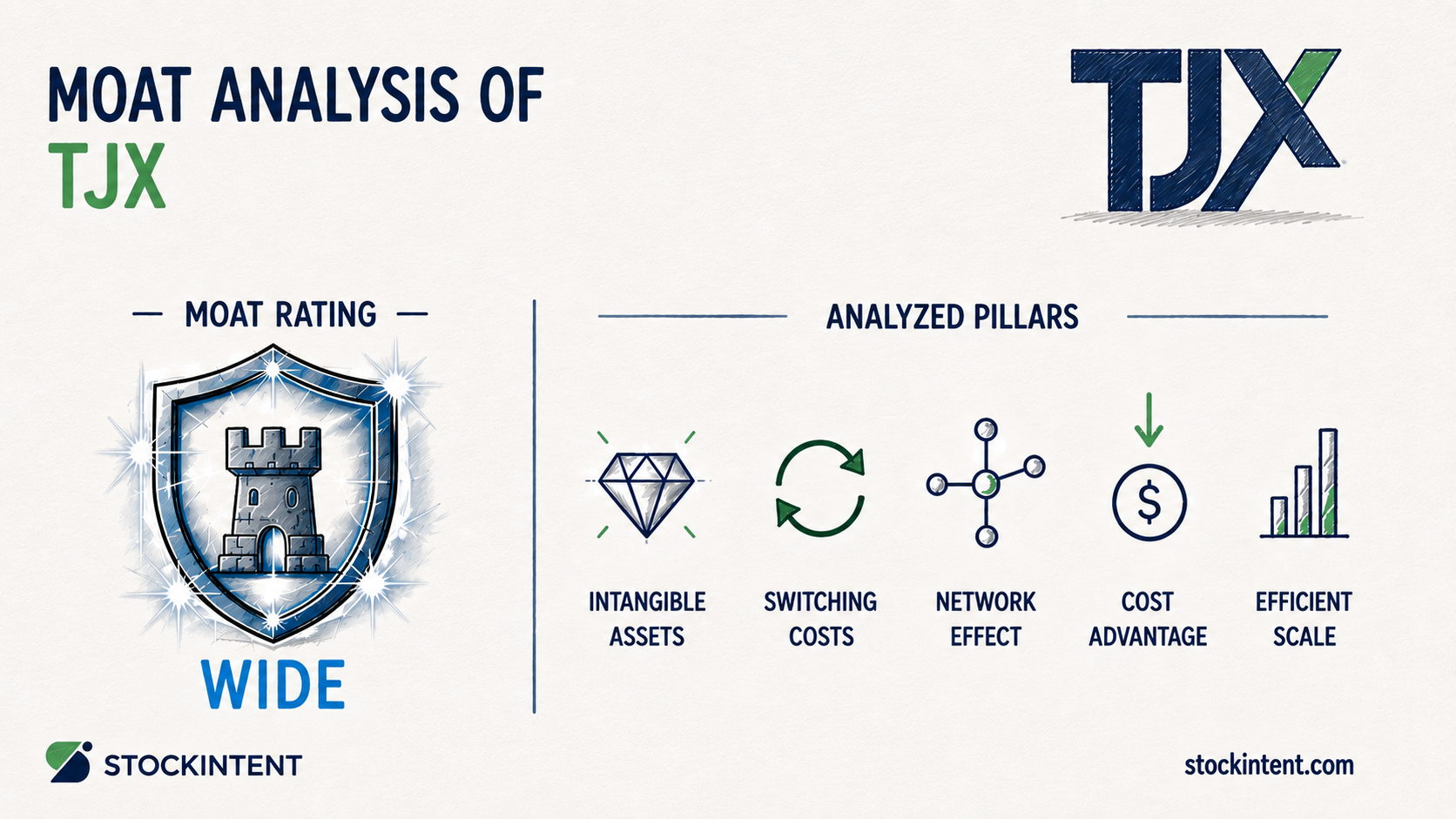
TJX carries a Wide Moat rating with a Stable trend and Medium uncertainty. That verdict reflects a business built on procurement scale and operational execution. In fiscal 2026, TJX generated $60.4 billion in net sales (up 7% year-over-year), delivered 5% comparable sales growth, and posted a 12.1% pretax profit margin alongside $6.9 billion in operating cash flow.
Morningstar's 2026 analysis calls the company "structurally advantaged," citing global buying scale as the core edge that lets TJX source branded goods at 20%-60% below full-price retailers.
Here's what matters most at a glance:
On the Q4 FY2026 earnings call, management noted that customer perception of value "improved over the last six months" and that TJX maintained an "appropriate value gap" versus competitors. That supports the stable trend call. Still, the company's own FY2026 10-K acknowledges it operates in "highly competitive markets" and "may not be able to compete effectively," which keeps uncertainty at Medium rather than Low.
For long-term investors, the question is whether TJX can keep converting that buying scale into consistent traffic and margins.
TJX's moat rests on two dominant pillars: cost advantage and efficient scale. The other three pillars play smaller or negligible roles. Here's how each one actually works for the business.
Cost advantage: Strong. In FY2026, TJX turned $60.4 billion in net sales into a 12.1% pretax profit margin and $6.9 billion in operating cash flow. Those numbers don't happen by accident. TJX's buying organization sources branded goods opportunistically from a vast vendor base, often at 20%-60% below what full-price retailers pay. That gap is the engine of the business model. Because inventory turns quickly and the company avoids markdown risk through flexible buying, the cost structure compounds over time.
Efficient scale: Strong. Size matters in off-price retail, but not the way it does in every industry. TJX can absorb enormous, irregular inventory flows that would overwhelm smaller rivals. With $60.4 billion in annual sales, the company doesn't need the market to support multiple players at similar scale. That's the textbook definition of efficient scale, and it's why Ross Stores and Burlington remain meaningfully smaller despite decades of competition. TJX can keep opening stores and entering markets without saturating its own economics because the inventory pipeline is fragmented and opportunistic.
Intangible assets: Moderate. TJX has built real brand trust and merchant reputation over decades. Customers know the treasure-hunt experience and return for it. But this is not a patents-and-IP moat or a luxury brand with pricing power. The company's own success factors emphasize execution, vendor relationships, and merchandising skill rather than legally protected assets. The intangibles support the moat; they don't define it.
Switching costs: Weak to modest. Here's the truth: customers can walk into Ross, Burlington, or a discount section at Target tomorrow with essentially zero friction. There are no contracts, no loyalty programs that lock people in, and no technical barriers to leaving. Any repeat behavior is driven by habit and convenience, not structural switching costs. The treasure-hunt format creates loyalty-like behavior, but it's behavioral, not contractual.
Network effects: Not material. It is tempting to describe TJX's vast sourcing network as a network effect. It isn't. More buyers don't make the experience better for other buyers the way they do on a platform like Airbnb or Etsy. TJX's sourcing relationships represent procurement scale and execution muscle, not a self-reinforcing user network where participation by one party directly increases value for another. Calling this a network effect mischaracterizes the mechanics of the advantage.
| Moat Pillar | Strength | Why It Matters for TJX |
|---|---|---|
| Cost advantage | Strong | Opportunistic buying at scale creates persistent margin gap vs. full-price retail |
| Efficient scale | Strong | Absorbs irregular inventory flows that smaller rivals cannot handle |
| Intangible assets | Moderate | Brand trust and merchant reputation support traffic, but no protected IP |
| Switching costs | Weak to modest | Repeat behavior is habitual, not structural; easy to shop elsewhere |
| Network effects | Not material | Sourcing scale is procurement muscle, not a self-reinforcing user platform |
If you're evaluating these characteristics across other holdings, reviewing detailed financial metrics and rankings in StockIntent's company reports can help standardize the comparison.
TJX's competitive advantages translate into something investors can actually see: repeat traffic, durable margins, and cash generation that most retailers struggle to match. In FY2026, the company delivered 5% comparable sales growth across its banners, with Marmaxx up 5%, HomeGoods up 6%, and TJX Canada up 7%. Those aren't one-off numbers. They reflect customers who keep coming back for the treasure-hunt experience rather than waiting for sales or chasing promotions elsewhere.
The cost advantage and efficient scale show up most clearly in profitability. TJX posted a 12.1% pretax profit margin for fiscal 2026 and generated $6.9 billion in operating cash flow. Q4 gross margin reached 31.1% on merchandise margin gains. Off-price retail is supposed to be a low-margin business. These figures suggest TJX's procurement scale lets it operate differently.
But pricing power works differently here than at a luxury brand or a subscription platform. TJX can't simply raise prices because customers love the experience. Its 'pricing power' is really markdown avoidance, the ability to buy opportunistically and turn inventory fast enough that it doesn't need to discount heavily. That's a real advantage, but it's execution-dependent and sensitive to external shocks.
Here's where the moat looks thinner. Customer switching costs are weak. Shoppers can walk into Ross, Burlington, or Target's discount aisle tomorrow with zero friction. The off-price model itself is replicable, competitors already use it, and some of FY2026's strength may reflect favorable inventory conditions and consumers trading down rather than a purely structural edge. TJX is clearly the largest and best-executing off-price operator, but that leadership comes from scale and merchandising skill, not from a concept rivals cannot imitate.
Compared with department-store competitors, TJX looks structurally stronger on traffic and margin quality. Against Walmart or Target, its treasure-hunt proposition remains distinct even as those giants compete for the same value-conscious shoppers. The gap versus smaller off-price peers like Ross and Burlington appears substantial today, though not unbridgeable with enough time and capital.
TJX's moat is Stable to Modestly Widening. The off-price sector continues to benefit from value-seeking consumer behavior, but TJX's execution, not just industry tailwinds, keeps the trend pointed in the right direction.
The evidence for stability is concrete. TJX's market share improved to approximately 5.93% in Q1 2026, up from 5.79% the prior quarter. Management noted on the Q4 FY2026 earnings call that customer perception of value "improved over the last six months" and that TJX maintained an "appropriate value gap" versus competitors. When shoppers feel they're getting a better deal and the company is gaining share, the moat seems to hold up.
Still, geographic moderation warrants attention. TJX International decelerated from 7% comparable sales growth in FY2025 to 4% in FY2026, while Canada cooled from 10% to 7%. Marmaxx and HomeGoods held steady at 5% and 6% respectively. The divergence suggests TJX's competitive advantages may be more durable in North America than abroad, or that international execution simply faces tougher local conditions. Either way, it's a watch item.
Here's what investors should monitor over the next three to five years:
If you're tracking these metrics across multiple holdings, StockIntent watchlists let you organize margin trajectories and cash flow data into custom views that update as new filings arrive.
The FY2026 10-K keeps the assessment grounded. TJX explicitly states it operates in "highly competitive markets" and "may not be able to compete effectively." That is not false modesty. The off-price model is replicable, competitors already use it, and TJX's advantages derive from execution scale rather than structural barriers to entry.
The moat is durable because the company keeps executing, not because the model is impossible to copy.
We rate TJX's moat uncertainty as Medium. The business is more predictable than most retailers, but not as stable as a regulated utility or essential-services company. Two factors drive this rating: sales predictability and operating stability.
Revenue depends on customer traffic and value-seeking behavior, which held up well through FY2026 with 5% comparable sales growth across banners. The off-price model even provides some counter-cyclical resilience, shoppers trade down during weakness. Still, consumer spending cycles matter. TJX cannot control macro conditions, and its treasure-hunt format depends on a steady supply of branded merchandise that full-price retailers need to clear. That creates a dependency on the broader retail inventory cycle that adds variability.
Margins tell a similar story. The 12.1% pretax profit margin and $6.9 billion in operating cash flow for FY2026 demonstrate durable profitability, but management repeatedly flagged risks from labor costs, tariffs, freight expenses, and inventory-hedging volatility in the FY2026 10-K and earnings calls. These aren't abstract concerns. They directly threaten the cost-advantage pillar that underpins the entire moat. Favorable hedge positions and lower-than-expected tariff impacts helped FY2026 results, but those tailwinds may not repeat.
The balance sheet provides a buffer. Strong cash generation and manageable capital requirements, store growth, inventory, and logistics, suggest TJX can weather moderate shocks without strategic disruption. The plausible range of outcomes for competitive position over the next three to five years is moderately narrow. TJX has proven resilient through multiple cycles, and its scale advantages in sourcing and merchandising are genuinely durable. But execution sensitivity remains real. If disciplined buying weakens, if tariffs or labor costs spike materially, or if competitors close the value gap, margin and growth could decelerate faster than the headline moat rating implies.
Medium uncertainty, in our view, captures this accurately: TJX is unlikely to face a binary outcome, but the spread between upside and downside is wider than the current margin stability alone suggests.
TJX earns a Wide Moat with a Stable trend and Medium uncertainty. That verdict stands on procurement scale that produced $60.4 billion in FY2026 sales, a 12.1% pretax margin, and $6.9 billion in operating cash flow. The cost advantage and efficient scale are genuine, but they are execution-dependent rather than structurally protected.
Two issues matter most from here. First, International comparable sales decelerated to 4% in FY2026 from 7% in FY2025, which signals possible geographic variance in moat strength. Re-acceleration would confirm broad durability; continued slowing would raise questions about whether TJX's advantages travel as well abroad as they do in North America. Second, tariff and labor cost pressures threaten the core cost-advantage pillar. The FY2026 margin held firm, but management explicitly flagged these risks in the 10-K and earnings calls. Margin compression would directly undermine the economics that make this moat wide.
For investors evaluating long-term business quality, TJX remains a compelling case study in scale-driven compounding. The moat is durable because the company keeps executing, not because rivals cannot imitate the model. Watch banner-level comp trends, operating margin direction, and market share movement to judge whether that execution stays on track over the next three to five years.
Start your 7-day free trial and find quality compounders faster.
— StockIntent Score ╌ S&P 500